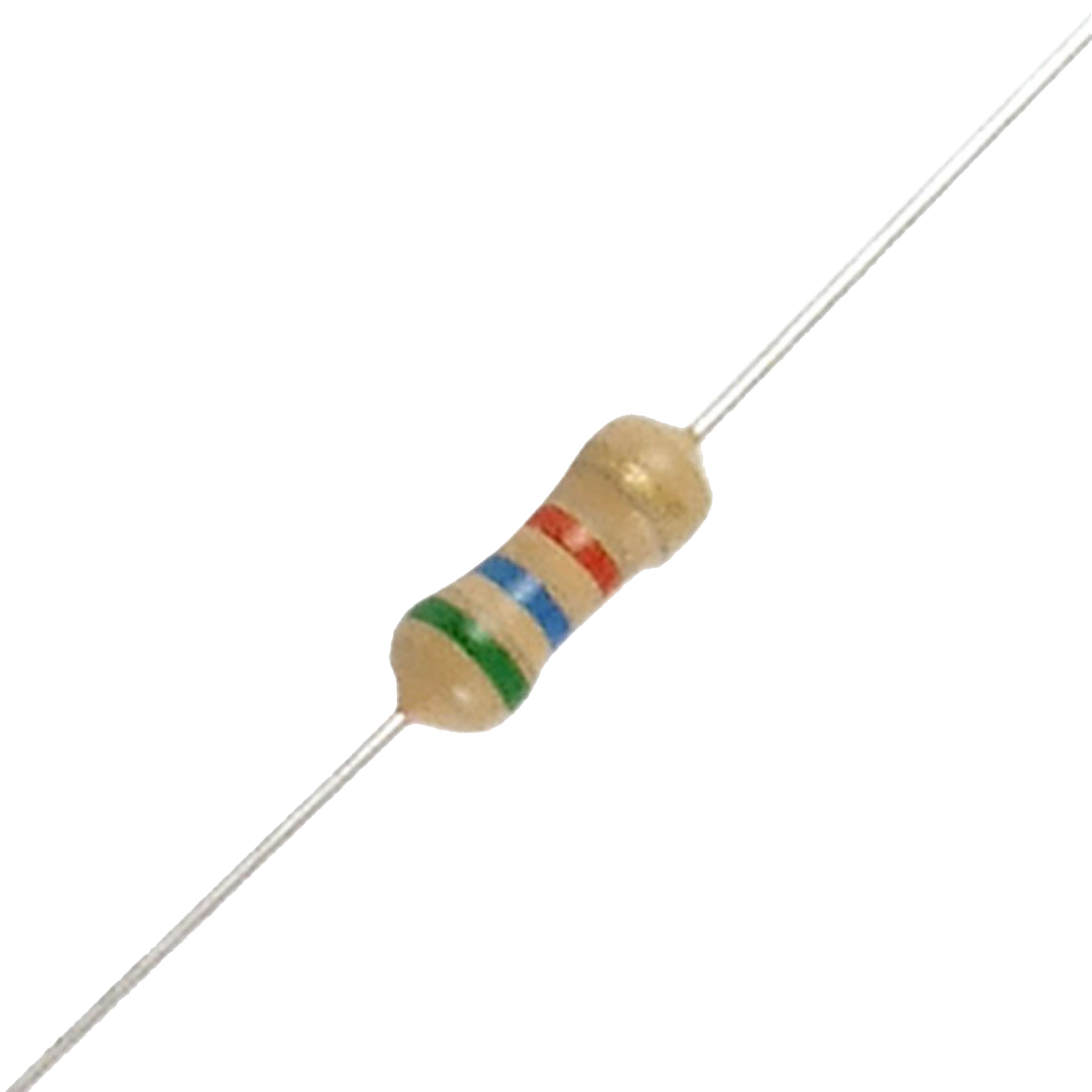
Resistors
A resistor is a component of an electrical circuit that resists the flow of electrical current. A resistor has two terminals across which electricity must pass, and is designed to drop the voltage of the current as it flows from one terminal to the next. A resistor is primarily used to create and maintain a known safe current within an electrical component.


- FIXED VALUE RESISTOR (Resistor Color Code Chart)
Band Color Options | Band 1 position No | Band 2 position No | Band 3 Multiplier Value | Band 4 Value Tolerance | |
Black | 0 | 0 | ×10° | --- | |
Brown | 1 | 1 | ×10¹ | ± 1% | |
Red | 2 | 2 | ×10² | ± 2% | |
Orange | 3 | 3 | ×10³ | --- | |
Yellow | 4 | 4 | ×10 | ---- | |
Green | 5 | 5 | ×10 | ± 0.5% | |
Blue | 6 | 6 | ×10 | ± 0.25% | |
Violet | 7 | 7 | -- | ± 0.1% | |
Gray | 8 | 8 | -- | ± 0.05% | |
White | 9 | 9 | -- | ---- | |
None | -- | -- | -- | ± 20% | |
Silver | -- | -- | × 0.1 | ± 10% | |
Gold | -- | -- | × 0.01 | ± 5% |
- The first band gives the first digit.
- The second band gives the second digit.
- The third band indicates the number of zeros.
- The fourth band is used to show the tolerance (precision) of the resistor

Calculation | First Band | Second Band | Third Band | Fourth Band | Calculated Value |
Color Name Position Value | Red Violet Green Silver 2 7 105 +10% | 2700000W +10% 2.7MW +10% | |||
Resistor | Calculation | First Band | Second Band | Third Band | Fourth Band | Calculated Value | Measurement Value by Digital Multimeter |
Sample #1 | Color Name Position Value |
|
|
| |||
Sample #2 | Color Name Position Value |
|
|
| |||
Sample #3 | Color Name Position Value |
|
|
| |||
There are two types of variable resistors
1. Potentiometer 2. Preset


Potentiometer Preset
| Standard Value (Written on the Device Surface) | The measured value by Multimeter (between two end terminals) |
Potentiometer |
|
|
Preset |
|
|
Polarised (Electrolytic Capacitors , Value Above 1uF )


Unpolarised (Non- Electrolytic) Small Value below 1uF)


 A number code is often used on small capacitors where printing is difficult:
 - µ means 10-6 (millionth), so 1000000µF = 1F
- n means 10-9 (thousand-millionth), so 1000nF = 1µF
- p means 10-12 (million-millionth), so 1000pF = 1nF
Its maximum Value is given on the surface


Specification of capacitor
1. Voltage Rating: All capacitors have a voltage rating. This tells you how much voltage the dielectric (insulator) can withstand before allowing DC to pass between its plates
2. Capacitor’s Rating:- The capacitance rating is there because the energy stored in a capacitor is W = 1/2CV2, where W is the stored energy in joules, C is the capacitance rating in farads, and V is the voltage on the cap. The cap's capacitance is a necessary specification because circuit design and performance hinge on having caps the correct value for the configuration of the circuit.
Function :- A capacitor stores electric charge. A capacitor is used with a resistor in a timing circuit. It can also be used as a filter, to block DC signals but pass AC signals
| Standard Value (Written on the Device Surface) | The measured Value by LCR meter |
Capacitor #1 |
|
|
Capacitor #2 |
|
|
DIODE

Testing diodes:- (By using DMM(Digital Multimeter)
Set your meter to the diode test mode. Connect the red meter lead to the one terminal of diode. Connect the black meter lead to the other terminal and then reverse the meter leads . If a good diode will read a JUNCTION DROP voltage of between .25V and .7V in one direction (.3V for Ge diode and .7 for Si diode in forward break over voltage ). And other direction will show open or overload (OL). If both the direction showing OL or showing same voltage, then the diode is faulty. Normally the reverse break down voltage is high in case of Si or Ge. So we cannot test the reverse break down voltage by DMM.
In Zener diode testing is similar to the silicon diode testing.
Zener diode :-
Zener diodes are used to maintain a fixed voltage. They are designed to 'breakdown' in a reliable and non-destructive way so that they can be used in reverse to maintain a fixed voltage across their terminals.They are connected with a resistor in series to limit the current.


| Symbol | Device Number | Forward Voltage Drop | Reverse Voltage Drop |
Silicon Diode |
|
|
|
|
Zener Diode |
|
|
|
|
LED (Specify the Color) |
|
|
|
|
Diode specifications characteristics and parameters:-
- Semiconductor material:
- Forward voltage drop (Vf):
- Peak Inverse Voltage (PIV)
- Maximum forward current:
- Leakage current
- Junction capacitance:
- Package type
Diode | Maximum Current | Maximum Reverse Voltage |
1N4001 | 1A | 50V |
1N4002 | 1A | 100V |
1N4007 | 1A | 1000V |
1N5401 | 3A | 100V |
1N5408 | 3A | 1000V |
Type | Colour | IF max. | VF typ. | VF max. | VR max. | Luminous intensity | Viewing angle | Wavelength |
Standard | Red | 30mA | 1.7V | 2.1V | 5V | 5mcd @ 10mA | 60° | 660nm |
Standard | Bright red | 30mA | 2.0V | 2.5V | 5V | 80mcd @ 10mA | 60° | 625nm |
Standard | Yellow | 30mA | 2.1V | 2.5V | 5V | 32mcd @ 10mA | 60° | 590nm |
Standard | Green | 25mA | 2.2V | 2.5V | 5V | 32mcd @ 10mA | 60° | 565nm |
High intensity | Blue | 30mA | 4.5V | 5.5V | 5V | 60mcd @ 20mA | 50° | 430nm |
Super bright | Red | 30mA | 1.85V | 2.5V | 5V | 500mcd @ 20mA | 60° | 660nm |
Low current | Red | 30mA | 1.7V | 2.0V | 5V | 5mcd @ 2mA | 60° | 625nm |
IF max. | Maximum forward current, forward just means with the LED connected correctly. |
VF typ. | Typical forward voltage, VL in the LED resistor calculation. This is about 2V, except for blue and white LEDs for which it is about 4V. |
VF max. | Maximum forward voltage. |
VR max. | Maximum reverse voltage You can ignore this for LEDs connected the correct way round. |
Luminous intensity | Brightness of the LED at the given current, mcd = millicandela. |
Viewing angle | Standard LEDs have a viewing angle of 60°, others emit a narrower beam of about 30°. |
Wavelength | The peak wavelength of the light emitted, this determines the colour of the LED. nm = nanometre. |
A transistor is a semiconductor device used to amplify and switch electronic signals and power. It is composed of a semiconductor material with at least three terminals for connection to an external circuit. The transistor is an arrangement of semiconductor materials that share common physical boundaries. Materials most commonly used are silicon, gallium-arsenide, and germanium, into which impurities have been introduced by a process called “doping.


| Type of transistor (PNP or NPN) | Symbol | Voltage C to B terminal | Voltage B to C terminal | Voltage C to E terminal | Voltage E to C terminal | Voltage B to E terminal | Voltage E to B terminal |
BC548 |
|
|
|
|
|
|
|
|
SL100 |
|
|
|
|
|
|
|
|
The leads are labeled base (B), collector (C) and emitter (E).
Transistor Testing with a Digital multimeter
Note down the transistor number which is specified on the device surface.- The base-emitter (BE) junction should behave like a diode and conduct one way only.
- The base-collector (BC) junction should behave like a diode and conduct one way only.
- The collector-emitter (CE) should not conduct either way.
- You have to note how much forward bias voltage from these six tests.
The diagram shows how the junctions behave in an NPN transistor. The diodes are reversed in a PNP transistor but the same test procedure can be used.

Structure | This shows the type of transistor, NPN or PNP. The polarities of the two types are different | ||||||||||
IC max. | Maximum collector current. | ||||||||||
VCE max. | Maximum voltage across the collector-emitter junction. You can ignore this rating in low voltage circuits. | ||||||||||
hFE | This is the current gain (strictly the DC current gain). The guaranteed minimum value is given because the actual value varies from transistor to transistor - even for those of the same type! Note that current gain is just a number so it has no units. | ||||||||||
Ptot max. | Maximum total power which can be developed in the transistor, note that a heat sink will be required to achieve the maximum rating. This rating is important for transistors operating as amplifiers, the power is roughly IC × VCE. Follow the device specification from the according to the device number. | ||||||||||
NPN transistors | |||||||||||
Code | Structure | Case style | IC max. | VCE max. | hFE min. | Ptot max. | Category (typical use) | Possible substitutes | |||
BC107 | NPN | TO18 | 100mA | 45V | 110 | 300mW | Audio, low power | BC182 BC547 | |||
BC108 | NPN | TO18 | 100mA | 20V | 110 | 300mW | General purpose, low power | BC108C BC183 BC548 | |||
BC108C | NPN | TO18 | 100mA | 20V | 420 | 600mW | General purpose, low power | ||||
BC109 | NPN | TO18 | 200mA | 20V | 200 | 300mW | Audio (low noise), low power | BC184 BC549 | |||
BC182 | NPN | TO92C | 100mA | 50V | 100 | 350mW | General purpose, low power | BC107 BC182L | |||
BC182L | NPN | TO92A | 100mA | 50V | 100 | 350mW | General purpose, low power | BC107 BC182 | |||
BC547B | NPN | TO92C | 100mA | 45V | 200 | 500mW | Audio, low power | BC107B | |||
BC548B | NPN | TO92C | 100mA | 30V | 220 | 500mW | General purpose, low power | BC108B | |||
BC549B | NPN | TO92C | 100mA | 30V | 240 | 625mW | Audio (low noise), low power | BC109 | |||
2N3053 | NPN | TO39 | 700mA | 40V | 50 | 500mW | General purpose, low power | BFY51 | |||
BFY51 | NPN | TO39 | 1A | 30V | 40 | 800mW | General purpose, medium power | BC639 | |||
BC639 | NPN | TO92A | 1A | 80V | 40 | 800mW | General purpose, medium power | BFY51 | |||
TIP29A | NPN | TO220 | 1A | 60V | 40 | 30W | General purpose, high power | ||||
TIP31A | NPN | TO220 | 3A | 60V | 10 | 40W | General purpose, high power | TIP31C TIP41A | |||
TIP31C | NPN | TO220 | 3A | 100V | 10 | 40W | General purpose, high power | TIP31A TIP41A | |||
TIP41A | NPN | TO220 | 6A | 60V | 15 | 65W | General purpose, high power | ||||
2N3055 | NPN | TO3 | 15A | 60V | 20 | 117W | General purpose, high power | ||||
Please note: the data in this table was compiled from several sources which are not entirely consistent! Most of the discrepancies are minor, but please consult information from your supplier if you require precise data. | |||||||||||
PNP transistors | |||||||||||
Code | Structure | Case style | IC max. | VCE max. | hFE min. | Ptot max. | Category (typical use) | Possible substitutes | |||
BC177 | PNP | TO18 | 100mA | 45V | 125 | 300mW | Audio, low power | BC477 | |||
BC178 | PNP | TO18 | 200mA | 25V | 120 | 600mW | General purpose, low power | BC478 | |||
BC179 | PNP | TO18 | 200mA | 20V | 180 | 600mW | Audio (low noise), low power | ||||
BC477 | PNP | TO18 | 150mA | 80V | 125 | 360mW | Audio, low power | BC177 | |||
BC478 | PNP | TO18 | 150mA | 40V | 125 | 360mW | General purpose, low power | BC178 | |||
TIP32A | PNP | TO220 | 3A | 60V | 25 | 40W | General purpose, high power | TIP32C | |||
TIP32C | PNP | TO220 | 3A | 100V | 10 | 40W | General purpose, high power | TIP32A | |||
Please note: the data in this table was compiled from several sources which are not entirely consistent! Most of the discrepancies are minor, but please consult information from your supplier if you require precise data. | |||||||||||